For a long time, commuting into Atlanta felt like part of the deal.
If you wanted access to bigger business opportunities, professional connections, client meetings, and a polished work environment, you planned your day around the drive. You left early. You checked traffic. You built in extra time. You accepted that a full workday might come with a long stretch of windshield time on either side.
But work has changed.
For many professionals in Marietta, the question is no longer, “Can I work outside a traditional office?” The better question is, “Where do I do my best work?”
And more often, the answer is not a kitchen table, a crowded coffee shop, or a daily commute into Atlanta. It is somewhere closer to home, with the structure, focus, and professionalism people still need to do great work.
That is one reason having a coworking space in Marietta, GA has become more relevant for remote workers, consultants, small business owners, and hybrid teams. Professionals are not necessarily looking to work less. They are looking to make their workdays make more sense.
The Atlanta Commute Still Comes With a Real Cost
Let’s be clear: Atlanta is still an important business center.
It is home to major companies, strong industries, creative communities, and countless professional opportunities. This is not about dismissing the city or pretending those opportunities do not matter.
The issue is the daily cost of getting there.
A commute is not just the time between your driveway and your destination. It is the earlier alarm. The traffic app check. The extra gas. The parking plan. The mental math around whether one client meeting is worth losing most of the morning. It is also the energy it takes to shift from traffic mode into focused work mode once you finally arrive.
According to the Atlanta Regional Commission’s 2025 Regional Commuter Survey, published in 2026, Metro Atlanta commuting has settled into a “new normal” shaped by telework, hybrid schedules, and flexible hours. The survey found that telework remains much higher than it was before the pandemic, even as some workers return to offices more regularly.
TomTom’s Atlanta traffic data also shows that congestion is still a real part of the Metro Atlanta experience. In other words, flexible work may have changed the rhythm of commuting, but it has not made traffic disappear.
For many Marietta professionals, that reality has shifted the question.
Instead of asking, “How do I get to Atlanta every day?” they are asking, “Do I actually need to?”
Hybrid Work Is Not a Temporary Phase
For a while, flexible work was treated like a temporary adjustment. Something companies and workers would do until everything went back to normal.
But the old normal has not fully returned.
Hybrid work has become a lasting part of professional life for many remote-capable employees. The Atlanta Regional Commission found that the share of workers who reported teleworking at any time rose from 43% in 2019 to 60% in 2025. Full-time telework also increased from 6% to 20% during that same period.
National workplace research points in the same direction. Gallup reports that among remote-capable employees, the majority prefer hybrid work. About six in 10 want a hybrid arrangement, while fewer than 10% prefer to be fully on-site.
That does not mean everyone wants to work from home forever. In fact, that is the whole point.
People want flexibility, but they also still need structure. They want control over their schedule, but they also need places that support focus, collaboration, calls, meetings, and the occasional “I need to get out of my house before I start answering emails from the laundry room” kind of day.
Hybrid work is not just about location. It is about choice.
And that choice is creating demand for flexible workspace in Marietta that can adapt to different kinds of workdays.
Working From Home Solved One Problem, But Created Others
Working from home can be wonderful.
There is no commute. The coffee is familiar. The dress code is forgiving. You can fold laundry between calls, let the dog out at lunch, and avoid the strange little office politics around who keeps microwaving fish.
But even the best home office has its limits.
For some people, home is full of distractions. For others, it is too quiet. Some professionals struggle to separate work from personal life when both happen in the same room. Others miss the natural energy that comes from being around people who are also building, creating, solving, planning, and trying to get through their inbox before noon.
Then there are the practical challenges.
Not every home is set up for client calls. Not every meeting belongs on Zoom. Not every consultant, freelancer, or small business owner wants to host a serious conversation from the kitchen table. And sometimes, you just need a door you can close.
That is where working closer to home, but not always at home, starts to make sense.
A local coworking space gives professionals a way to keep the flexibility they value while adding back the pieces that home does not always provide: focus, separation, meeting rooms, reliable internet, a professional setting, and a little bit of human interaction.
Flexibility is a gift. But flexibility without structure can start to feel a little like floating.
Marietta Is Becoming a Place to Work, Not Just a Place to Live
Marietta has always had its own identity, but more professionals are beginning to see it as more than the place they return to after the workday.
It is a city with its own business community, restaurants, local services, events, professional networks, and civic life. It has the character of a historic town with the practical advantages of being part of a much larger metro area.
The U.S. Census Bureau estimates Marietta’s 2025 population at 63,574, up from its 2020 estimate base of just over 61,000. That growth matters because it reflects something many people who live and work here already feel: Marietta is not standing still.
Cobb County is also continuing to invest in business growth, workforce initiatives, redevelopment, and small business development. Local networking events, economic development efforts, and entrepreneurial support all contribute to a professional ecosystem that exists outside Atlanta’s core.
That matters for the person who wants to build a consulting practice without spending every day on I-75.
It matters for the small business owner who wants to meet clients near the Square.
It matters for the remote employee who wants a professional place to work without driving into Midtown.
It matters for the hybrid team that needs a meeting room in Marietta instead of asking everyone to fight traffic for a two-hour planning session.
Working locally is not a downgrade. For many professionals, it is a smarter way to build the workday.
The New Sweet Spot Is Close to Home, But Not Always at Home
The modern workday is not one-size-fits-all.
Some days call for quiet, heads-down focus. Some days call for collaboration. Some days are packed with calls. Some days need a conference room, a whiteboard, and enough coffee to make a plan come together.
That is why more professionals are looking for a middle ground.
They do not necessarily want to commute into Atlanta every day. They also do not necessarily want to work alone from home all week. They may not be ready for a traditional office lease, but they do need something more reliable than a coffee shop table next to the espresso machine.
That middle ground is where coworking can be especially useful.
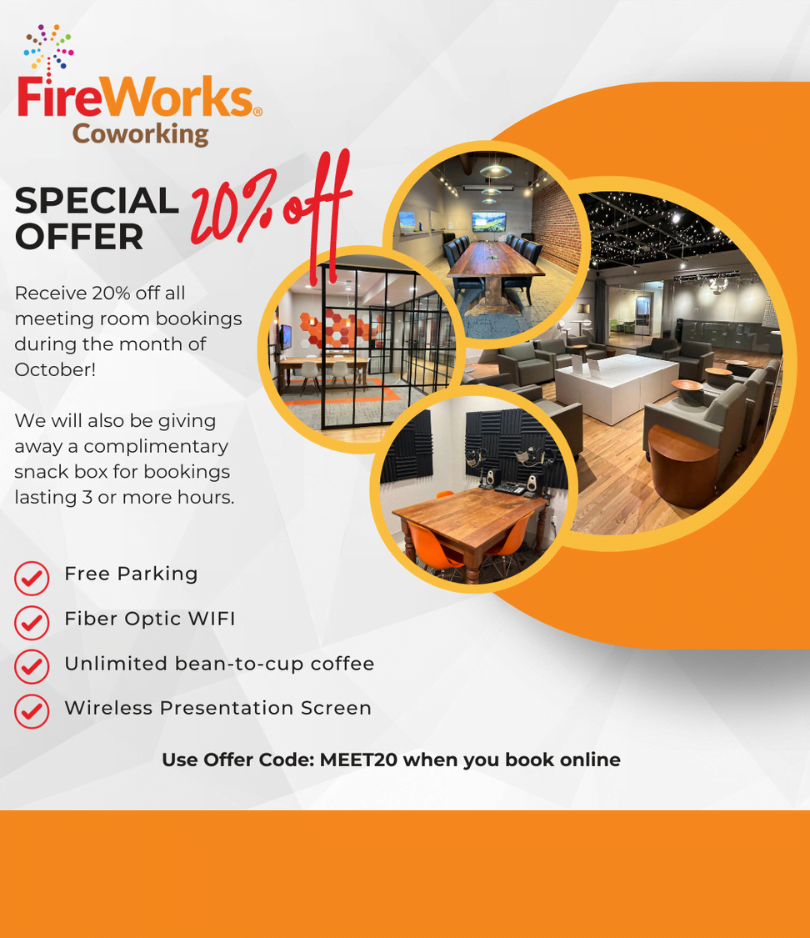
At FireWorks Coworking, that can look different depending on the person. For a remote worker, it might be a day pass when home feels too distracting. For someone building a more regular rhythm, it might be a coworking membership that gives them a dependable place to work each week. For a consultant, coach, or small business owner, it might be access to meeting rooms for client conversations, trainings, interviews, or planning sessions.
For someone who needs more privacy, it might be a private office that gives their business a more permanent home base without the weight of a traditional long-term lease.
And as more professionals look for that next step, FireWorks is expanding its private office options with seven new Micro Plus offices designed for focused, flexible work in Marietta.
That is the real value of flexible workspace. It does not force every professional into the same solution. It gives people options based on how they actually work.
Working Locally Can Still Grow Your World
One of the quiet benefits of working closer to home is that your professional world starts to overlap with your actual community.
That can be powerful.
When you work locally, you are more likely to meet other local business owners, nonprofit leaders, consultants, creatives, and entrepreneurs. You learn who is building what. You find nearby vendors. You hear about events. You make referrals. You become part of the business fabric around you.
That is harder to do when your workday is split between your house and a commute.
It is even harder when you are fully remote and your only professional interactions happen through scheduled video calls.
Local workspaces help create the in-between moments. The quick kitchen conversation. The introduction you did not know you needed. The person who knows a person. The casual “what are you working on?” that turns into a collaboration, a referral, or simply a more connected day.
There used to be an assumption that serious work happened in the city. That assumption is changing.
Today, professionals can build strong businesses, manage major projects, serve clients, lead teams, and grow meaningful careers from many different places. The important thing is not always being in the busiest part of the metro area. The important thing is having the right environment, the right tools, and the right support.
For Marietta professionals, working closer to home does not mean stepping away from opportunity. It means creating a workday with more focus, less friction, and more connection to the community around you.
It means you can still drive into Atlanta when you need to, but you do not have to build your entire professional life around that commute.
It means you can meet clients locally, host your team nearby, find focus outside your house, and build relationships in the same community where you live.
Marietta is no longer just the place professionals come back to after work. Increasingly, it is where the work itself is happening.
Curious what working closer to home could look like for you? Whether you need a day pass, a coworking membership, a meeting room, or a private office in Marietta, FireWorks Coworking gives you a flexible place to work without giving up professionalism, focus, or community.