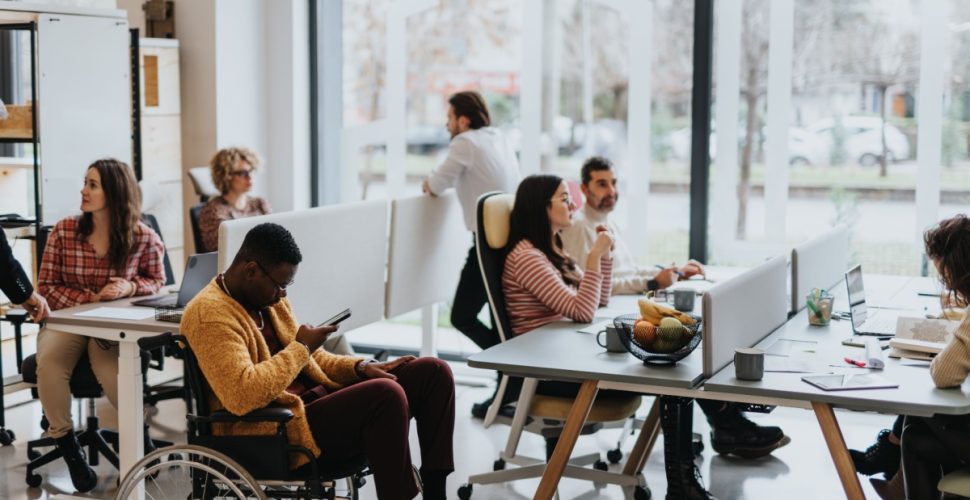
For years, conversations about the future of work centered around big cities, major corporations, and sweeping global trends. Headlines focused on Silicon Valley, Manhattan, and remote teams scattered across time zones. But something quieter and arguably more interesting has been unfolding closer to home.
The future of work in Marietta is not theoretical. It is already happening.
You can see it in the growing number of professionals like FireWorks Members, Laura Beth Daws with LBD Communications, and Sam and Lori Newman from Newman Web Solutions choosing to stay local instead of commuting into Atlanta. You can see it in the entrepreneurs like Nick and Theresa with Season Marietta and Roy Fleeman with Office Hours building businesses within a few miles of the Marietta Square. You can see it in the hybrid teams who no longer need a traditional long term lease but still need professional space to meet, collaborate, and focus.
What has changed is not whether people work. It is how and where they choose to do it.
From commuting culture to local ecosystems
For decades, professional life in metro Atlanta revolved around commuting. Success meant driving into the city, signing long leases, and measuring stability in square footage. Suburbs like Marietta were where people lived, not necessarily where they built.
That division is dissolving.
Remote work accelerated the shift, but it did not create it. Technology made it possible to work from anywhere. What professionals quickly realized, however, is that “anywhere” is not always optimal. Working entirely from home blurred boundaries. Productivity fluctuated. Isolation crept in. In fact, Gallup found that 25% of fully remote employees report loneliness at work, compared with 16% of exclusively on site workers and 21% of hybrid workers. At the same time, many remote professionals began seeking spaces outside the home that offered focus, structure, and a sense of connection. Research has also found that remote workers spend approximately one third of their remote work hours outside the home in places like cafés, coworking spaces, or the homes of friends and family. Meanwhile, committing to traditional office space in Marietta with multi year leases and overhead that does not flex with your business began to feel unnecessarily rigid and expensive.The result has been a hybrid path. Professionals are choosing local ecosystems over distant headquarters. They are designing work lives that keep them embedded in their community while still giving them the structure and professionalism they need.
This is where flexible office space in Marietta has become more than a convenience. It has become part of the entire culture so much so that coworking close to home has become a non negotiable.
Marietta is uniquely positioned for this shift
Not every city is built to support this evolution. Marietta is. As the #7 highest ranked suburbs in Georgia, it is large enough to have momentum and opportunity, yet small enough that relationships that you can easily build matter. It offers walkable districts, strong small business networks, and proximity to residential neighborhoods. Parking is accessible. Meetings can happen without a logistical production. Lunch is five minutes away, not forty.
In an era when professionals are reexamining how they spend their time, these details are no longer minor. They are decisive.
When your workspace is close to home, you gain back hours from commuting every week. And for anyone who has had the extreme misfortune of a 9-5 commute on 285… I don’t have to tell you how life changing cutting that out can be. When your office is near other local businesses, you increase the likelihood of spontaneous collaboration. When your environment feels connected to your actual life, work becomes more sustainable.
The future of work is not only remote. It is local.
Visibility as a competitive advantage
There is another layer to this shift that often goes unnoticed. In a market like Marietta, visibility is currency.
Digital marketing is essential as we are entering the age of AI, but local presence builds something different. When you work in a collaborative, professional environment surrounded by other entrepreneurs and local business owners, you become known. Familiarity builds trust. Trust builds referrals. This is especially relevant for small business owners and consultants in Marietta. The more your name circulates naturally in conversation, the less you have to rely on cold outreach or constant advertising. Flexible coworking spaces and local networking groups support that kind of visibility in ways traditional offices often do not. They bring together diverse industries under one roof, creating informal networks that compound over time.
Redefining productivity
One of the most significant shifts in the future of work is the redefinition of productivity. Hours logged are no longer the primary measure of effectiveness. Clarity, focus, and output matter more than hours logged thus reshaping what a true work life balance means to both the employee and the employer.
Professionals are asking different questions. Where do I think best? Where do I take better meetings? Where do I feel energized instead of depleted? Where does my work feel taken seriously? The answers often point back to the environment.
A reliable meeting room in Marietta is not simply a room. It is a signal to clients. Stable, high speed internet is not a luxury. It is baseline infrastructure. Quiet focus space is not indulgent. It is strategic.
When the environment supports the work, mental energy is preserved for higher leverage tasks. That preservation compounds into better decisions, stronger client relationships, and more consistent progress.
Community as infrastructure
For years, community in coworking was marketed as a perk. Coffee, events, shared tables. While those elements matter, they miss the larger point.
Community is infrastructure.
Entrepreneurship without community can be isolating. Remote work without collaboration can narrow perspectives. When professionals operate entirely alone, blind spots persist longer. Momentum can stall without feedback or accountability.
Being surrounded by other builders changes the dynamic. You overhear conversations that spark ideas. You learn which vendors others trust. You gain insight into pricing, marketing strategies, and operational challenges. You are reminded that growth is not linear and that others are navigating similar questions.In a city like Marietta, where many businesses are locally rooted, that proximity becomes an accelerant. It turns independent professionals into participants in a larger ecosystem.
Flexibility as stability
There is a misconception that flexibility signals uncertainty. In today’s market, the opposite is true. For hybrid teams, coworking spaces have become particularly powerful. Employees can work remotely part of the week and still gather in person when collaboration matters most. Entrepreneurs can host client meetings without carrying the overhead of an entire private suite. Growing companies can expand as revenue grows, not before.
In Marietta, this kind of flexibility aligns with how modern businesses actually operate. It respects cash flow. It respects life outside of work.
The cultural shift beneath the surface
Perhaps the most interesting part of the future of work in Marietta is cultural.
Professionals are becoming more intentional about how they spend their time. Commutes are being evaluated against quality of life. Workspaces are being compared against energy and focus. Community is being evaluated against real connection, not just social media engagement.
This intentionality is reshaping expectations. People want spaces that feel professional but not sterile. Structured but not rigid. Community oriented but not overwhelming.
They want environments that support ambition without sacrificing balance.
Marietta’s scale makes this possible. It allows professionals to build serious businesses without disappearing into anonymity. It offers room for growth without demanding excess.
Looking ahead
The future of work in Marietta will not be defined by skyscrapers or massive corporate campuses. It will be defined by interconnected local professionals who choose environments that amplify their strengths.
Flexible office space, coworking communities, and hybrid models are not transitional stages. They are foundational elements of a new normal.
As more entrepreneurs and remote professionals continue to plant roots here, the ecosystem will only strengthen. The city will become more interconnected. Visibility will increase. Collaboration will deepen.
The shift is already underway.
The question is not whether work is changing. It is whether your environment reflects that change.
In Marietta, the professionals who are adapting early are building more than businesses. They are building infrastructure for the way work actually happens now.